In this article, readers will explore the intriguing story behind Sebastian Vettel’s 2013 Monaco Grand Prix performance and the unique challenges posed by the Red Bull RB9 during that race. Known for its dominance throughout the 2013 Formula 1 season, the RB9 had, surprisingly, a few vulnerabilities particularly on the twisty streets of Monaco. We will dive deep into the technical aspects of the RB9, Vettel’s driving performance, the race conditions, and why Monaco proved to be the RB9’s only real weakness that year.
The Dominance of the Red Bull RB9 in 2013
The Red Bull RB9 was one of the most formidable Formula 1 cars in recent history. Designed by the highly skilled team at Red Bull Racing and powered by a Renault engine, it combined aerodynamic brilliance with exceptional mechanical grip. Throughout the 2013 season, the RB9 consistently outperformed its rivals, helping Sebastian Vettel’secure his fourth consecutive World Drivers Championship.
The RB9 excelled on traditional high-speed circuits where its exemplary downforce and efficient power delivery allowed Vettel to dominate qualifying sessions and races alike. However, the 2013 Monaco Grand Prix, staged on one of the tightest street circuits in the world, exposed certain limitations in the car’s setup and performance. Known for its narrow roads and numerous tight corners, Monaco demands precision, high traction at low speeds, and impeccable mechanical balance, areas where the RB9 encountered difficulties.
Why Monaco is a Unique Challenge
The Monaco GP is unlike any other race on the Formula 1 calendar. Its short and twisty nature emphasizes driver skill, precision, and strategic racecraft over sheer speed. Unlike traditional circuits, Monaco requires cars to manage delicate throttle inputs and maintain high traction through slow-speed corners a foil for any car that relies heavily on aerodynamic downforce at high speeds.
Moreover, the RB9 was optimized primarily for circuits favoring aerodynamics and high-speed stability. The complex street layout at Monaco, with its infamous tight chicanes and slow turns, demanded a different approach to mechanical setup, with a focus on increased suspension compliance and enhanced traction control.
Vettel’s 2013 Monaco GP Performance
Despite driving the fastest car of the season, Vettel faced numerous challenges at Monaco in 2013. During the race weekend, the RB9 didn’t provide the same edge it had on other tracks, and Vettel’s qualifying performance was uncharacteristically off the pace compared to his own standards that year.
The key problem lay in tire degradation and balance on the slow-speed corners. The RB9 s stiff suspension setup, optimized for rapid cornering and downforce efficiency, made tire management difficult in Monaco s stop-start driving rhythm. Vettel’struggled to maintain consistent tire temperatures, leading to reduced grip as the race progressed.
However, Vettel demonstrated masterful racecraft and strategic decision-making, managing to secure valuable points despite the handicaps the car presented. His ability to extract the best from the RB9 under these conditions highlighted his status as one of the sport s all-time great drivers.
Technical Challenges of the RB9 at Monaco
The RB9 s chassis and aerodynamic package made it a lean, aggressive car on most circuits, but at Monaco, this translated into a lack of mechanical grip and poor traction out of slow corners. The high downforce setup worked against the RB9 in the low-speed, twisty layout where aerodynamic load has a limited effect.
Another contributing factor was the RB9’s braking system sensitivity, which made controlling entry speeds into tight corners challenging. The car’s brake balance was fine-tuned for more flowing circuits, and adapting it to Monaco s demands proved difficult.
Red Bull engineers attempted multiple setups throughout the weekend to improve mechanical grip and tire longevity, but compromises had to be made, often resulting in a package that was less competitive than usual.
Visualizing the RB9 s Monaco Struggles
The images below provide a glimpse into the RB9 as driven by Sebastian Vettel during the 2013 season, capturing its typical high-performance design that excelled outside Monaco yet struggled on the streets of Monte Carlo.
 While this image from the German GP showcases the RB9 performing on a grand prix circuit where it was dominant, it contrasts with the difficulties faced during the Monaco event.
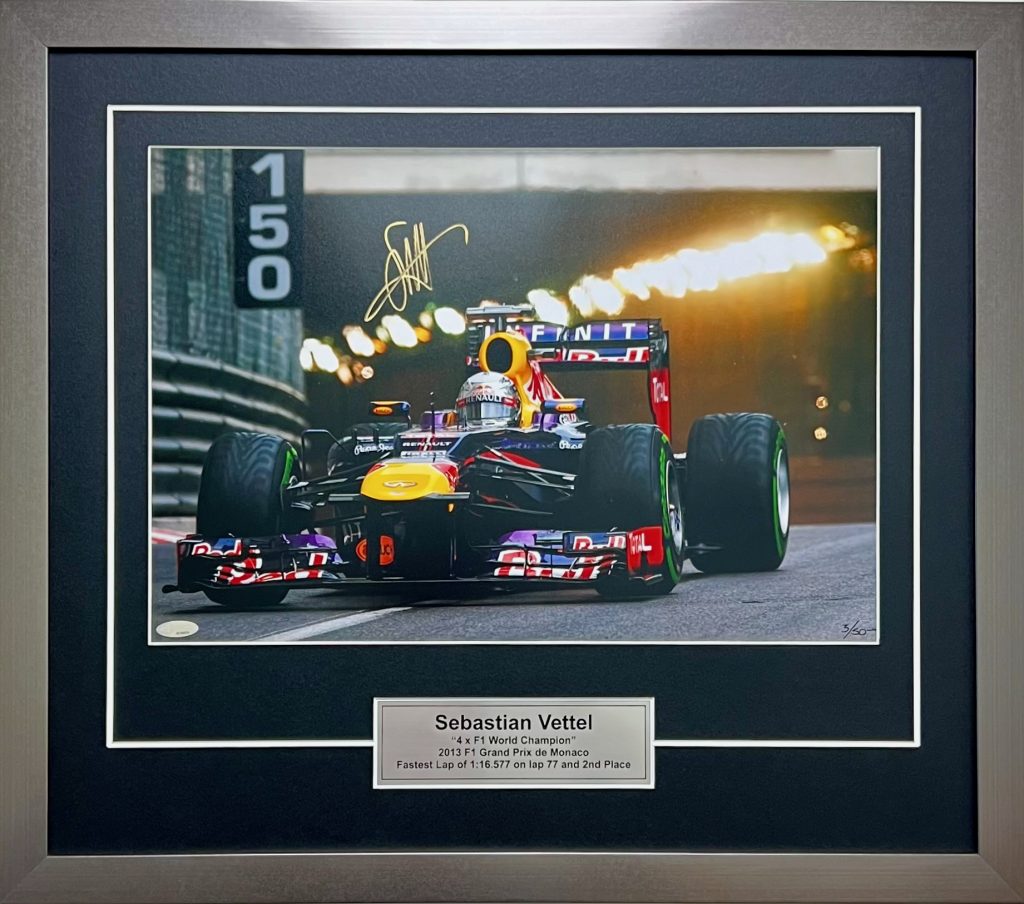 This autographed photo from the 2013 Monaco GP highlights the historical significance of Vettel’s efforts at the Monaco circuit, marking a rare challenge for the RB9 during a dominant season.
 Another shot of the RB9 from the German GP illustrating the car’s aerodynamic finesse and performance in conditions suited to its design philosophy.
Conclusion
The 2013 Monaco Grand Prix remains a fascinating chapter in the story of Sebastian Vettel and the Red Bull RB9. While the RB9 was virtually unbeatable across most circuits, Monaco proved to be its Achilles s heel, exposing inherent limitations in mechanical grip, tire management, and braking sensitivity.
Despite these challenges, Vettel’s exceptional skill and racecraft at Monaco enabled him to still extract significant performance, showcasing how even the most finely-tuned machines depend heavily on the driver behind the wheel. The Monaco GP in 2013 serves as a reminder that in Formula 1, even a dominant car like the RB9 can encounter unique challenges on the world s most demanding tracks.


// Discussion